



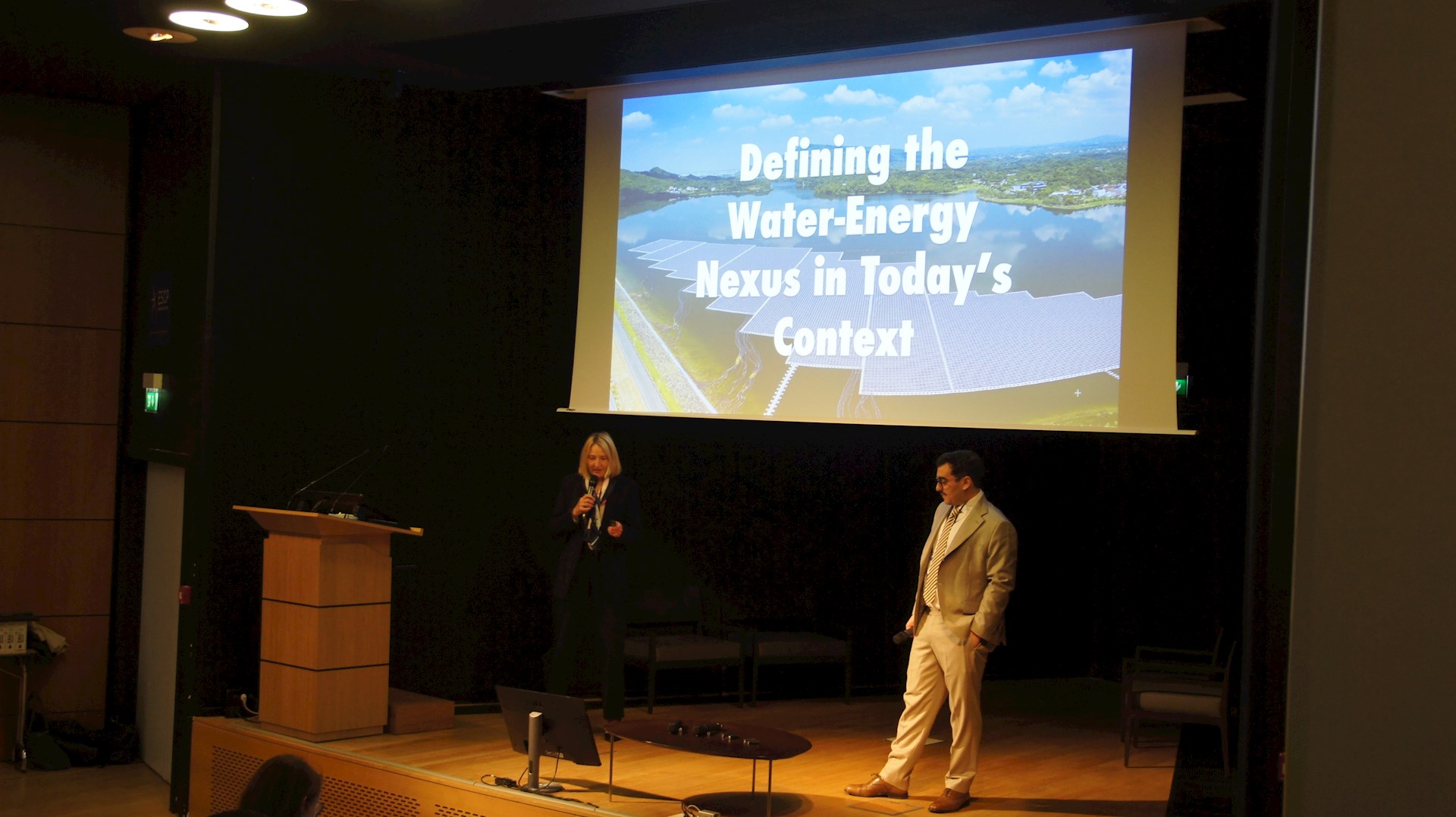
On 27 April, ESCP Business School's MSc in Energy Management (MEM), the ESCP Alumni Energy Group and the ESCP Energy Society co-hosted the Watts & Waves Forum, a full-day event at the Montparnasse campus dedicated to the water-energy nexus. Around 150 alumni, students, practitioners and external professionals gathered for a programme that brought together regulators, scientific researchers, operators, financiers and entrepreneurs to address one of the energy transition's most under-recognised constraints.
The forum was opened by Prof. Gorgi Krlev, Associate Dean and Full Professor of Sustainability and Impact at ESCP and Director of the RESET Research Centre, who welcomed attendees and delivered the keynote address. Reflecting on the Energy Society’s and Alumni Association Energy Group’s activities throughout the year, he emphasised the importance of systemic thinking within ESCP’s educational vision. This set the foundation for the event’s central premise: that water and energy should be understood not as separate challenges, but as one interconnected physical system governed through distinct institutions, ministries, and corporate functions.
The discussion highlighted that the gap between what is technically possible and what is ultimately implemented is less a question of technological capability than of institutional coordination and leadership — a challenge to which business schools are uniquely positioned to contribute.
The day was conceived and led by Anne Jourdain (ESCP Alumni Energy Group) and Kassim Abdul Malak (President, ESCP Energy Society and MEM Candidate), who set the morning’s intellectual anchor by mapping how the nexus already shapes industry value chains, and which transition pathways amplify or relieve the pressure.
Setting the Lens: From Physical System to Strategic Constraint
The morning session featured a deep dive from Anne Coudrain, Senior Researcher at the CNRS, on the global water cycle and the ways it is now structurally disrupted: groundwater depletion, glacial retreat and shifting precipitation patterns. The session reframed water not as a sustainability concern but as a physical input every energy producer, agricultural operator and city has been quietly relying on without pricing.
Panel 1 - Water-Energy Challenges in the Industry
An Insider Perspective, brought together Bikramjit Sengupta (Global Asset Management Consultant at GE Vernova and MEM Alumnus), Barthelemy Boillot (Chief of Staff at ENGIE and MEM Alumnus) and Darrell Leroux (Energy & Climate Affairs at FNSEA ), moderated by Joseph Wadlegger (MEM Candidate). The discussion ranged from how hydrology now shapes power and gas curves, to how thermal power siting decisions assume hydrological conditions that no longer hold, to the day-to-day operational pressures climate stress places on French agriculture.
"Having the opportunity to discuss with industry insiders and scientists like Anne Coundrain and Phillipe Négrel is really what makes the difference in this kind of event." Paul Pineau, ESCP MEM Student
From Diagnosis to Deployment
The afternoon opened with Arnaud Bazire, Executive Vice President of Water France at SUEZ, who delivered the day’s headline operator-perspective intervention. Drawing on SUEZ’s experience operating French water infrastructure under climate stress, he described an industry where energy considerations are now embedded in every infrastructure decision, but where capital and regulation have yet to catch up with the pace of change.
A bridge intervention from Philippe Négrel, Director of Water at the BRGM (Bureau de Recherches Géologiques et Minières), set the evidence base for Panel 2. Speaking on the state of French aquifers and the data infrastructure available to local decision-makers, Philippe set out where the science is now strong enough to support regulation, and where blind spots remain.
Panel 2 - Global Water-Energy Challenges, Local Nexus Solutions
The session brought together Philippe Négrel, Marie-Anaïs Berline (Founder of Look4Impact and member of Circulab), and Mathilde Augé (Banque Populaire Rives de Paris). The conversation centred on what it actually takes for a local nexus project to move from idea to deployment: the financing structures, the permitting realities, the design methodologies, and the data each party brings to the table.
From Insight to Implementation
The closing programme was handed over to ESCP's own entrepreneurial ecosystem. Maeva Tordo, Head of ESCP Blue Factory, presented the school's incubator and several portfolio ventures relevant to the nexus, followed by a startup segment featuring Metron, Seabex and Stemtech. Kassim Abdul Malak closed the day with reflections on what the forum had set in motion, and on the role of the ESCP community – alumni, faculty, students and partners – in carrying the work forward.
We extend our sincere gratitude to all speakers, moderators, panellists and partners whose engagement made the Watts & Waves Forum possible. Special thanks to Anne Jourdain and the ESCP Alumni Energy Group for their valued partnership in bringing the alumni network into the discussion, as well as to the Energy Society team for their dedication and extensive behind-the-scenes preparation.
This forum marks the beginning of an ongoing series of engagements between the ESCP community and industry practitioners shaping the water-energy nexus. More importantly, it reinforces our responsibility to equip future energy leaders with the insights required to successfully navigate this increasingly interdependent system. We look forward to continuing these exchanges and to working together to address the challenges of the water-energy nexus in the years ahead.




 Facebook
 Linkedin
 Instagram
 Youtube
 EMC Newsletter