



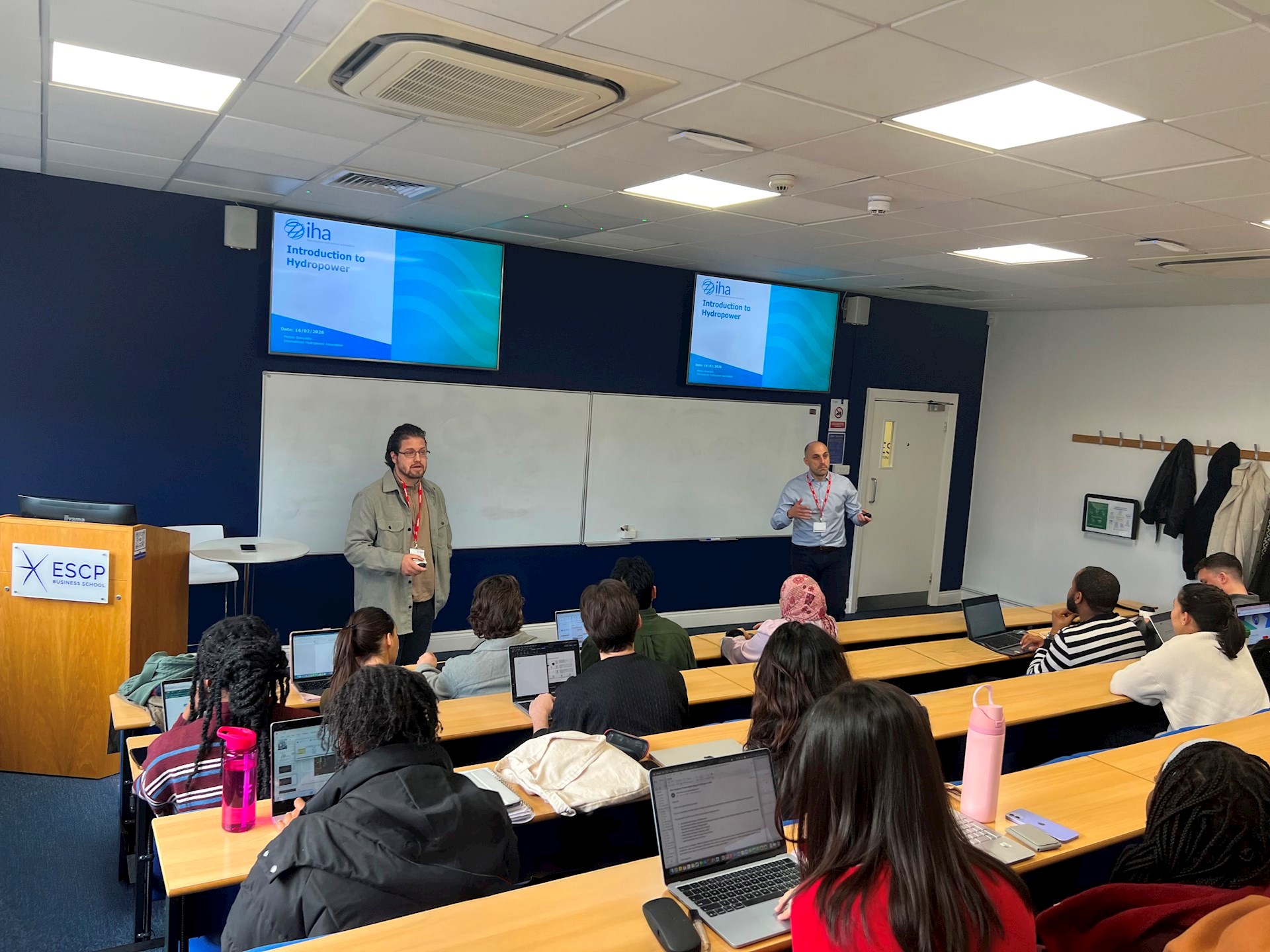
On 16 February, the MSc in Energy Management (MEM) Cohort welcomed the International Hydropower Association (IHA) to ESCP’s London campus for a deep dive into one of the world’s most established and increasingly strategic renewable energy technologies: hydropower.
Led by IHA's Matteo Bianciotto, Head of Research, and Brandon Marler, Senior Policy Officer, the session offered an overview of hydropower, its global pipeline, and the challenges and opportunities available therein, covering the technology's basics and building toward system-level complexity by region.
They were also joined by IHA's Marta Bottini, European Regional Lead; Iryna Petriashvili, Head of Membership; Isma Khuzaima Mansor, Southeast Asia Regional Lead, Sarawak Energy Berhad Assistant General Manager, Corporate Performance & Strategy Management; and Taqi Shah, Pumped Storage Policy Intern. Matteo, Brandon, and Marta returned to the classroom not only as IHA representatives but also as MEM alumni.
Matteo set a distinctive tone by encouraging students to challenge assumptions and question any points of disagreement. This approach fostered a culture of constructive debate and inclusivity, helping the cohort connect classroom learning with the realities of the sector.
How hydropower really works
Students were guided through the core components of hydropower plants, their operation, and the critical role of the reservoir, presented not merely as infrastructure but as a key enabler of control, reliability and value creation.
A central part of the discussion focused on the classification of hydropower technologies through the lens of flexibility, highlighting two primary categories: conventional hydropower and pumped-storage hydropower. The session explored how these technologies differ not only in design and operational logic, but also in their strategic role within power systems—particularly as grids that integrate growing shares of variable renewables. Participants were introduced to the idea that flexibility is no longer a “nice-to-have” but an increasingly vital value stream.
“One of the most striking takeaways was the longevity of hydropower plants, with some facilities operating for over 100 years. This highlights the significant potential for long-term value creation and reinforces hydropower’s role as a sustainable renewable energy source.” Chidinma Ayoola, ESCP MEM Student.
The reality of development and value creation over time
Moving beyond the technical aspects, the session emphasised the need to view hydropower as long-term infrastructure, where value creation spans decades and is shaped by permitting processes, engineering complexity, financing conditions, and stakeholder alignment.
“In terms of personal key learnings, there is one point I would like to stress: although hydropower is one of the most efficient renewable energy technologies, it is highly capital-intensive and requires long development timelines, especially for greenfield conventional projects. The extensive engineering, permitting, and construction phases can span many years, making hydropower less competitive in the short term compared to wind and solar projects. For this reason, hydropower should be considered strategic national infrastructure, requiring strong government support and country-level sponsorship.” Sokate Yebesse Mamba Doliveira, ESCP MEM Student.
Where growth is next
The IHA team reminded students that hydropower is not a “closed chapter” technology. Significant untapped global capacity remains, with Africa and Asia identified as the most promising regions for future development, particularly as energy systems search for firm capacity and flexibility to complement wind and solar.
We extend our sincere gratitude to the IHA and all speakers for delivering such an insightful and engaging session, and a special thanks to our MEM alumni—Matteo Bianciotto, Brandon Marler, and Marta Bottini—for strengthening the link between the specialisation and the IHA—one of the energy sector’s leading institutions.
Useful links
ESCP Business School
MSc in Energy Management
International Hydropower Association




 Facebook
 Linkedin
 Instagram
 Youtube
 EMC Newsletter