| |
| |
|
Editorial
We're delighted to announce the appointment of the new ESCP Energy Society board members for the 2025–2026 term. Elected by the dynamic twelfth cohort of MSc in Energy Management (MEM) students, this talented team is ready to lead an engaging and impactful year, bringing to life initiatives that will further strengthen ESCP’s energy management community. To read more about the society and its upcoming activities, click here.
Upcoming Event:
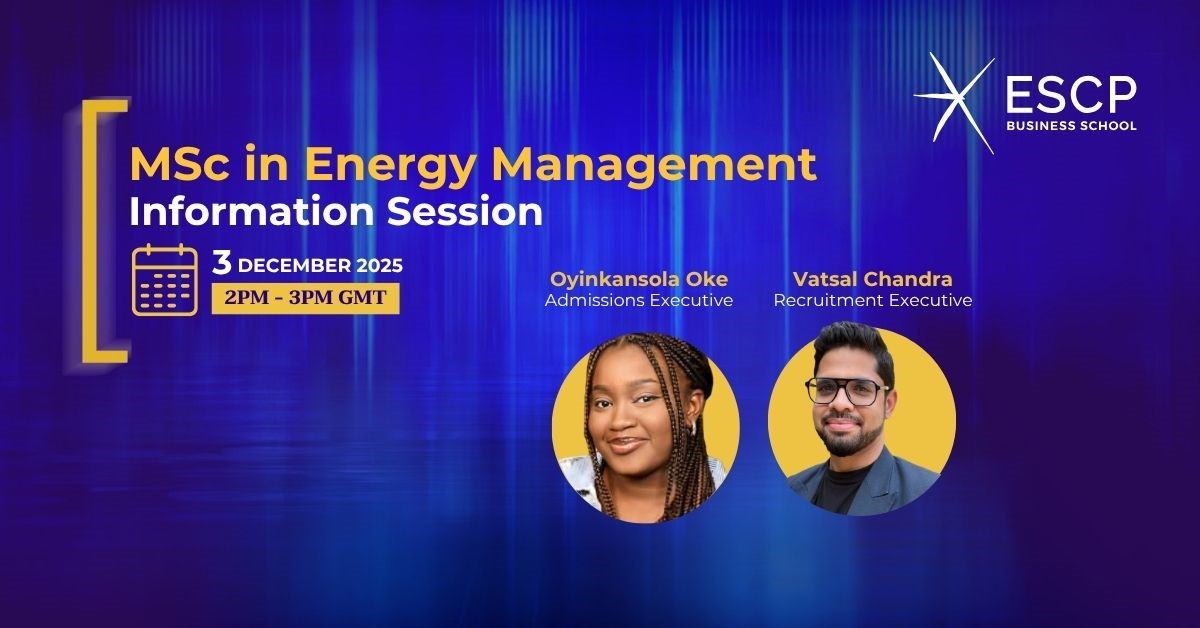
MSc in Energy Management Info Session: If you are interested in joining our postgraduate MSc in Energy Management (MEM), we would like to invite you to join our webinar on 3 December. To find out more, click here.
In case you missed it:
Here's our latest research, "Concentrated Solar Heat for Oil Refineries: Cutting Emissions, Not Performance", authored by ESCP Alumnus Julian Ignacio Prieto Prieto, Drilling Engineer at Ecopetrol and recipient of the MSc in Energy Management Class of 2024 Best Thesis Award. Read more here.
Energy Programmes at ESCP:
Admission process for the 2026 intake of our MSc in Energy Management is open. To find out more about the specialisation, please click here.
Our Executive Master in Future Energy is accepting applications for the February 2026 intake. For more information on the programme, click here.
Finally to keep-up-to-date on all activities at the Centre, we invite you to join our LinkedIn group Energy Management @ ESCP Business School.
|
| |
|
| |
|
Events
|
|
We're thrilled to invite you to an exciting and informative session where you can discover more about the admission process of the MSc in Energy Management.
In this session, we'll delve into the following engaging topics:
- Insights into ESCP Business School
- A comprehensive overview of the MSc in Energy Management
- A detailed look at the curriculum
- Exploring the Company Consultancy Project & Specialization Tracks
- Career outcomes and alumni overview
- Discovering more about the admissions process
Moreover, you'll have the chance to interact with our recruiter and admissions team and current students in real-time and get your questions answered. Applications are currently open, so don't miss out!
|
|
Latest News
|
Tuesday, November 25, 2025
ESCP Business School and its Energy Management Centre (EMC) are delighted to announce the appointment of the new Energy Society board members for the 2025–2026 term.
Elected by the dynamic twelfth cohort of MSc in Energy Management (MEM) students, this talented team is ready to lead an engaging and ...
Monday, November 24, 2025
This great initiative aims to bring together students who are passionate about broadening their understanding of the energy sector, and fostering cross-cultural exchange, shared learning, and a strong sense of community – all while enjoying great food and meaningful conversation.
Led by the newly elected ...
|
|
|
|
Our Mission
|
|
|
The EMC Advisory Board
|

The EMC Advisory Board is comprised of top energy experts from the world's industry leaders in both the public and private sectors.
- The curriculum of the MSc in Energy Management, ensuring the specialisation meets the needs of participants on academic and professional levels.
- Research that makes significant impact on best business practices.
- Current and future activities which benefit the EMC's partners, affiliates, students and alumni.
|
|
Energy Programmes
|
London - Paris - Internship
|
|

|
|
|
|
Research
|
EMC Working Papers
Decarbonising Steam: A Strategic Imperative for the Oil Refining Sector
Steam is the lifeblood of petroleum refineries, powering turbines, heating, and driving critical processes—yet generating it consumes up to 30% of a refinery's energy and accounts for roughly a third of its greenhouse gas emissions. Conventional steam production, reliant on fossil-fuelled boilers, is challenging to decarbonise without significant capital expenditures, and rarely yields meaningful emission reductions. With such a sizable environmental footprint, the pressing challenge is clear: how can refineries sustainably produce steam at scale? This article explores a compelling answer—concentrated solar thermal (CST)—and evaluates its potential to transform Colombia’s refinery sector, making efficiency and sustainability not just aspirational goals, but achievable realities.
|
|
EMC Working Papers
1. Introduction
The European Union (EU) is navigating a transformative period in its energy landscape, driven by the urgent necessity to tackle climate change and ensure sustainable energy security. As the world increasingly recognizes the dangers of climate disruption, the EU has positioned itself at the forefront of global efforts to reduce carbon emissions and foster a clean energy transition. In line with the ambitious European Green Deal, which aims to make Europe the first climate-neutral continent by 2050, the EU has set a bold target: achieving at least 42.5% renewable energy consumption by 2030, with aspirations to reach 45% [1]. Here's a concise summary of the current and upcoming trends in renewable energy demand and requirements across Europe. One of the upcoming requirements for Europe is the need to address seasonal variations in renewable energy production. Renewable sources, such as wind and solar, are inherently intermittent, leading to fluctuations in energy supply. This intermittency poses challenges to grid stability and energy security, especially during periods of low wind or solar generation. Converting offshore wind energy into hydrogen for storage can provide a flexible and reliable solution for energy supply, especially during periods when wind production is low or when demand peaks. Conveying current trends of renewable energy demand and upcoming trend requirements using Europe’s electricity base load with modular nuclear power plants, an Ultra High Voltage Transmission Line is used to transfer renewable energy long distances. Converting offshore wind production may concentrate on hydrogen storage in seas for upcoming seasonal issues caused by renewable energy, and finally Vertical Integration, Customer-centric, acquiring the energy from suppliers through Power Purchasing Agreements (PPAs).
|
|
|
| |
|